How Modality Inc sticks you in the...

This will be my take on 3 apps from the Modality Inc factory of junk: Rohen's Photographic Anatomy Flash Cards, Clemente's Anatomy Flash Cards and Moore's Clinical Anatomy Flash Cards.
Disclaimer: I can only talk about Rohen's cards and Netter's Flash Cards, but since the previews (on the maker website/iTunes app store) are similar and the maker is one and the same, I will assume homogeneity between the three apps.
It is outraging to me how unbelievably unprofessional Modality had become. At the hefty price of 24.99 - a third of the cost of the FULL textbook (Moore, Clemente, Rohen or even Netter) - you get about 5% content of the physical volumes. With blatant mistakes. Conducive to learning, as my teachers would put it. My gripes:
- Mislabeled structures. Ex: Mislabeled penile urethra and corpus cavernosum. What if I wanted to learn ahead and would actually memorize this?
- Lack of structures: Whereas Rohen the book (which I own) has on average 20-40 labels per diagram, this piece of app has 2-3. The images are often 40-70% of the complete image in the hard-copy - this makes it sometimes very hard to figure out where you are, since you are missing key landmarks (a testimony that the program was created by programmers, not medical professionals). I have a good feeling that had they put the full image, we would be able to figure out a way to navigate it with the iPhone gestures. For that price I would appreciate to have at least 10-12 labels. Remember: this is not a 5$ app.
- Lack of details: no information on the structures at the 'back of the card'
- No landscape, really??!!
Conclusion: The trio of apps from Modality Inc. is not worth your money. It will not save you time by making your heavy books portable, rather it will give you an illusion of knowledge. I can only recommend the Netter's Flash cards, which were produced - at least so it feels - by a completely different team, in the times when apps were not mass-stamped to reach economies of scale, but created to advance knowledge and produce more qualified med students.

Couldn't resist
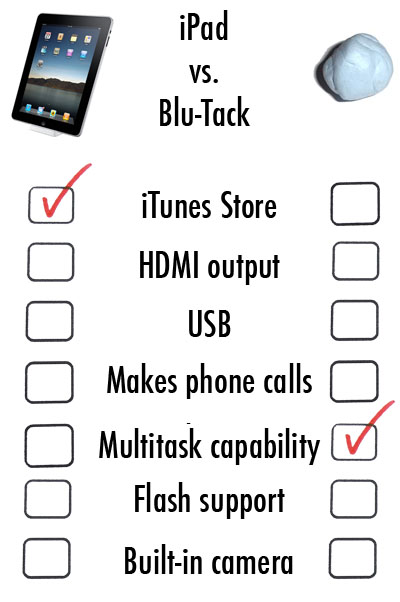 |
| http://s1.b3ta.com/host/creative/1279/1264637379/blutack.jpg |
Some meaningful posts coming soon. I couldn't resist this one, especially in light of recent problems with not even a year old piece of equipment from Apple. Thank God for 1 year warranties.
Poll: What is (was) your plan B?

The *Other* category had the following answers:
- Become a science teacher
- Military
- I would apply to pharmacy/graduate studies and apply med again each year
- Public Health (ideally for the WHO)
- Computer science
So you like the beach? (or how to get into the Caribbean medical schools)

First and foremost, Happy New 2010 Year!
I know that I had specifically said that this website would be concerned only with Canadian medical school application and student experience, but let us face it - some less fortunate folks will not be able to get in. No matter what candidate, regardless of their merit, despite their MCAT scores, GPA's and - the odds of getting in are never 100% (if you don't believe me, read this post by P.L.). As my recent poll showed (link coming soon), some will keep reapplying, but there are only so many times you can waste your money and time. Some will go into research, some will go into public health or choose a related medical career. Nobody, however, at least among the 61 people who responded, said they will try the Caribbean schools. I never considered the option myself, but I feel now that the more choices you have, the more freedom you end up with. Coincidentally, I found an interesting post about the Caribbean medical school applications by Asad Raza, a Toronto undegrad graduate who studied at one of the Caribbean schools.
Everything you wanted to know about medical school but were afraid to ask me directly

The following is a growing set of questions you asked me. Well, technically, you asked Google, and Google told you to see me*. So here it is, without any particular order or priority.
On inspiration and creativity in medicine

Inspiration seems to be the theme of the month for me, so I thought I would share an inspirational moment with you. Below is a 20 minute speech by Ken Robinson, who, as I learned recently, is one of the best speakers you will ever hear. Although he talks about education in general and its relation to creativity, this talk got me thinking about premedical and medical education.
Poll: What do you think about the MMI's (multiple mini-interviews)?
As it stands right now, I think the MMI's are the only specific and sensitive way to weed out people who are into medicine for the wrong reasons. You cannot prepare for the situations, thus you will be forced to act genuinely. If you think people can fake it, you underestimate the level of stress associated with the situations. They might ask you to talk to "your friend" in one, but most of them will be difficult and nerve wrecking.
Wisdom from Dr Patch Adams

I was very fortunate to be able to attend a lecture given by one the world's most caring doctors. He, who's name made Robin Williams 20 million dollars, he who told us that he could not stand his first year in peds because his view of medicine was so staggeringly different. I am, of course, talking about Dr. Hunter Campbell Adams, more commonly known as Patch Adams.
Although there were many great things in that speech, I wanted to share a couple because of their impact on me personally.
Choosing a medical specialty
It is an unfortunate truth of experiential reality that choices are not clear-cut, and the event window for choice may vanish before the information enabling the choice is present.
Eluki bes Shahar
For those lucky enough to have the need to contemplate this...

Ref: http://aggiepie.files.wordpress.com/2008/05/12medicalspecialtystereotypesfull.jpg

Ref: http://www.huffingtonpost.com/dr-peter-rost/want-to-become-a-doctor_b_20148.html (via BMJ?)
All jokes aside, researching which specialties you prefer early on in your medical school years has its advantages. These include the pre-clinical years as much as the later, more exciting time spent in the hospital rotations.
For pre-clinicals, you will want to get a mentor who practices in the specialty you are interested in. This will allow you to be in the hospital early on, with no pressure to perform. You'd be surprised how much you will notice when you are not concerned with evaluations/patient responsibility. You also, more importantly, get to see the "collective body" of the specialists. There are definite stereotypical traits attributable to some specialties more than to others. The common example would be a more commanding or dominating personality for surgery. Does that mean you cannot be a calm, mellow surgeon? Absolutely not! But the law of life is that you will find it much harder to be the exception.
For the clinical years, there is a lot more to do. For example, if you decide to aim for dermatology, you might want to make sure you get an invitation to Stockholm for their annual ceremony, or at least put in the extra effort to beef up your application. Another example would be doing extra electives at rural sites to get experience in self-reliance for a great career in family medicine. If you like a particular program, it is usually good to get an elective there. According to CaRMS, some universities openly state they have preferential treatment for people with whom their faculty is familiar from such electives.
For a competitive specialty, you would probably want to get involved in research in a related field. The reasons are twofold. Firstly, what better way to put your foot where your mouth is when it is time to back up your claim of interest in the specialty. Some elite residency programs in the States require you to have done research, published, or even to have a Msc degree. Secondly, don't neglect the opportunity to get to know the program director of your Oh-So-Desired-Specialty if you get a summer grant in their lab/hospital clinic. Although I will elaborate on it in later post, I would caution you from molecular biology research unless you absolutely love it and know exactly what you want to do. Most likely you are going to be a practicing clinician, so stick to the clinical.
Some residencies, it turns out, are more competitive and select from an extensive pool of medical graduates for a minute number of spots. You'll immediately recognize that this early preparation for one critical point in your life vaguely reminds you something...However, your competition just received a serious upgrade from the last time you had to prove you are better than the average Joe to the medical school admissions committee.
And finally, some serious tools:
- Careers in Medicine via AAMC (usually your career advising office will email you a password)
- Medical Specialty Aptitude Test
- The Ultimate Guide to Choosing a Medical Specialty
via Amazon
(The best book I found on the subject, although by no means perfect. In fact, much of it is focused on US specifics, which are somewhat irrelevant for hardcore Canadians like us. Don't feel insulted if you are from outside of Canada, I did mention in the prelude to this blog that I write for and about Canadian medical school applicants/students) - Your colleagues in upper years. Corner one and question them about their rotations in a given specialty. If you are extroverted enough, you could probably get away with leeching on to them for a day in the hospital. From my experience, there is much more amicability and much less cut-throat attitudes in medical school than there are in premed.


